
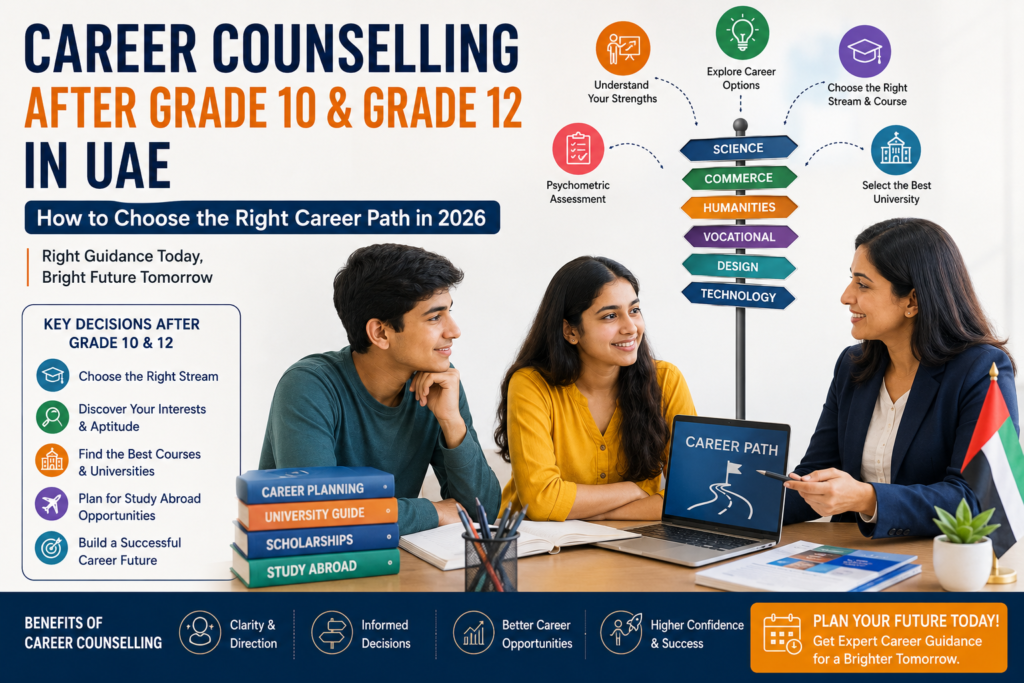
Choosing the right career after Grade 10 or Grade 12 is one of the most important decisions a student will make. Career counselling helps students understand their interests, strengths, aptitude, personality, and future career opportunities before selecting subjects, courses, universities, or study destinations. In the UAE, professional career counselling provides personalised guidance that helps students make informed academic and career decisions while avoiding common mistakes.
Why Career Planning Starts Earlier Than Most Students Think
Many students believe they only need career guidance after completing Grade 12. In reality, career planning should begin much earlier.
The choices made after Grade 10 often determine the academic options available after Grade 12, which in turn influence university admissions and future career opportunities.
Students in the UAE study under different education systems, including:
- CBSE
- ICSE
- British Curriculum
- International Baccalaureate (IB)
- American Curriculum
- UAE Ministry of Education Curriculum
Each curriculum has different subject choices, assessment methods, and university admission pathways. Without proper guidance, students may choose subjects that do not align with their long-term goals.
Professional career counselling helps students understand these pathways before making important academic decisions.
Why Career Counselling Is Important After Grade 10
Grade 10 is a turning point in a student’s academic journey. This is when many students must choose a stream or subject combination that will influence future university options.
The most common streams include:
- Science
- Commerce
- Humanities (Arts)
Many students select a stream based on family expectations, friends’ choices, or perceived earning potential rather than their own interests and abilities.
Career counselling replaces guesswork with structured decision-making.
A professional career counsellor helps students evaluate:
- Academic strengths
- Personal interests
- Aptitude
- Personality traits
- Learning style
- Long-term career aspirations
- Emerging industry trends
This approach increases the likelihood of choosing a stream that supports both academic success and long-term career satisfaction.
Choosing the Right Stream After Grade 10
Science
Science is often chosen by students interested in analytical thinking, research, healthcare, engineering, technology, or environmental sciences.
Possible career pathways include:
- Medicine
- Dentistry
- Pharmacy
- Engineering
- Artificial Intelligence
- Biotechnology
- Data Science
- Architecture
- Aviation
- Robotics
- Environmental Science
Science provides broad career opportunities but also requires strong commitment to mathematics and/or biology, depending on the chosen pathway.
Commerce
Commerce is suitable for students interested in business, finance, economics, entrepreneurship, accounting, and management.
Potential careers include:
- Chartered Accountancy
- Finance
- Investment Banking
- Marketing
- Business Management
- Human Resources
- International Business
- Digital Marketing
- Supply Chain Management
- Entrepreneurship
Commerce is an excellent option for students who enjoy problem-solving, business strategy, and working with numbers.
Humanities (Arts)
Humanities is ideal for students who enjoy communication, creativity, social sciences, languages, psychology, law, or public policy.
Career opportunities include:
- Psychology
- Journalism
- Law
- International Relations
- Education
- Graphic Design
- Media Studies
- Public Administration
- Social Work
- Content Strategy
- Civil Services
Contrary to common misconceptions, Humanities offers diverse and rewarding career opportunities across public and private sectors.
Common Mistakes Students Make After Grade 10
Many students make avoidable mistakes when selecting their academic stream.
Choosing What Friends Choose
Every student has unique strengths and interests. Following friends may lead to poor academic performance and dissatisfaction.
Following Family Pressure
Parents naturally want the best for their children, but career decisions should balance family guidance with the student’s interests and abilities.
Ignoring Emerging Careers
Today’s students have access to careers that did not exist a decade ago, including AI Engineering, Cybersecurity, UX Design, Cloud Computing, and Sustainability Management.
Career counselling helps students explore both traditional and emerging professions.
Choosing Based Only on Salary
A high-paying career is not always the right career. Long-term success depends on aligning skills, interests, values, and continuous learning.
Why Career Counselling Matters After Grade 12
After completing Grade 12, students face another significant decision: choosing the right university, degree programme, and career direction.
Questions commonly asked by students include:
- Should I study in the UAE or abroad?
- Which university is best for my chosen field?
- Which course offers strong career prospects?
- How do scholarships work?
- Which countries provide the best opportunities after graduation?
- What skills will employers value in the future?
Career counselling provides personalised answers based on the student’s academic background, goals, and financial considerations rather than one-size-fits-all advice.
Key Decisions Students Make After Grade 12
Professional career counselling helps students evaluate:
- Degree programme selection
- University selection
- Country selection
- Scholarship opportunities
- Entrance examination requirements
- English language proficiency tests
- Internship opportunities
- Future employability
- Postgraduate education options
The objective is to choose a pathway that aligns with both immediate academic goals and long-term career aspirations.
Career Counselling vs Advice from Friends and Family
Many students seek advice from relatives or friends who have already completed university. While personal experiences can be valuable, they may not reflect the student’s own strengths, interests, or the current job market.
Professional career counselling differs because it is:
- Personalised
- Evidence-based
- Supported by psychometric assessments
- Focused on long-term planning
- Updated with current education and employment trends
This structured approach helps students make informed decisions rather than relying solely on opinions.
How Psychometric Assessments Help Students Make Better Career Decisions
One of the biggest misconceptions about career counselling is that a counsellor simply suggests a career based on a student’s favourite subject. Professional career counselling is much more comprehensive.
Psychometric assessments provide scientific insights into a student’s interests, personality, aptitude, behavioural preferences, and learning style. When combined with counselling sessions, these assessments help identify career pathways that align with the student’s natural strengths and long-term goals.
A professional psychometric assessment may evaluate:
- Career interests
- Personality traits
- Numerical reasoning
- Verbal reasoning
- Logical thinking
- Spatial ability
- Leadership potential
- Creativity
- Communication preferences
- Emotional intelligence
- Decision-making style
These results should not be viewed as a final answer but as a valuable tool that supports informed decision-making.
Career Counselling for Different School Curricula in the UAE
The UAE is home to students studying under a variety of education systems. Every curriculum has unique subject combinations, assessment methods, and university admission requirements.
Professional career counselling takes these differences into account before recommending academic and career pathways.
Career Counselling for CBSE Students
CBSE students usually make important decisions after Grade 10 when selecting Science, Commerce, or Humanities.
Career counselling helps them:
- Understand subject combinations
- Explore university options in the UAE and abroad
- Identify suitable entrance examinations
- Compare career opportunities
- Build a long-term education roadmap
Career Counselling for British Curriculum Students
Students following the British curriculum make key decisions during GCSEs and A Levels.
Career counsellors help students:
- Select appropriate A Level subjects
- Understand university entry requirements
- Compare UK, UAE, Canadian, Australian, and European universities
- Align subject choices with future career goals
Career Counselling for IB Students
The International Baccalaureate offers flexibility, but selecting Higher Level (HL) and Standard Level (SL) subjects requires careful planning.
Career counselling helps IB students choose combinations that strengthen university applications while supporting their preferred career pathway.
Career Counselling for American Curriculum Students
Students following the American curriculum often need guidance on:
- Subject selection
- AP courses
- University applications
- Personal essays
- Scholarships
- Career planning
Career Counselling for MOE Curriculum Students
Students following the UAE Ministry of Education curriculum can also benefit from professional career guidance.
Counselling helps them understand:
- University admission requirements
- Local and international study opportunities
- Scholarship options
- Career pathways aligned with their academic strengths
Choosing the Right University After Grade 12
Selecting the right university is about much more than rankings.
Students should evaluate several important factors before making a final decision.
Academic Quality
Review the curriculum, faculty expertise, accreditation, and industry relevance of the programme.
Career Opportunities
Look for universities that provide internships, industry projects, career services, and strong graduate employability.
Scholarships and Financial Planning
Compare tuition fees, scholarships, living expenses, and return on investment.
Campus Environment
Students should also consider:
- Student support services
- Clubs and societies
- Research opportunities
- International exposure
- Exchange programmes
A university should support both academic development and personal growth.
Should You Study in the UAE or Abroad?
Many students wonder whether they should pursue higher education within the UAE or study internationally.
The answer depends on individual goals, academic performance, budget, and preferred career pathway.
Studying in the UAE may be suitable for students who wish to remain close to family while accessing internationally recognised institutions.
Studying abroad may provide:
- Global exposure
- Diverse learning environments
- International internships
- Cross-cultural experiences
- Expanded career opportunities
- Access to specialised programmes
A career counsellor helps students compare these options objectively rather than making decisions based on trends or assumptions.
Skills Every Student Should Develop for Future Careers
The future workplace values more than academic qualifications.
Students should continuously develop transferable skills such as:
- Critical thinking
- Communication
- Collaboration
- Creativity
- Digital literacy
- Data interpretation
- Problem-solving
- Leadership
- Adaptability
- Time management
These skills remain valuable across industries and support long-term career success.
Fast-Growing Career Opportunities in the UAE
The UAE continues to invest in innovation, technology, sustainability, healthcare, and entrepreneurship.
Some of the fastest-growing career areas include:
- Artificial Intelligence
- Machine Learning
- Cybersecurity
- Data Analytics
- Cloud Computing
- Renewable Energy
- Healthcare Technology
- FinTech
- Aviation Management
- Supply Chain Management
- Hospitality and Tourism
- Digital Marketing
- Environmental Science
- UX/UI Design
- Robotics
Students should explore careers based on both their interests and future industry demand.
Tips for Parents Supporting Career Decisions
Parents play an important role in helping students make confident career choices.
Here are some practical recommendations:
- Encourage open discussions about career interests.
- Avoid comparing your child with other students.
- Focus on strengths instead of weaknesses.
- Stay informed about changing career opportunities.
- Support exploration rather than forcing a particular profession.
- Consider professional career counselling before making major academic decisions.
When students and parents work together with an experienced career counsellor, decisions are generally more balanced and future-focused.
Frequently Asked Questions
1. What is the best time to start career counselling?
Students can benefit from career counselling from Grade 8 onwards, especially before selecting subjects or academic streams.
2. Is career counselling only useful after Grade 12?
No. Career counselling is valuable before Grade 10, after Grade 10, after Grade 12, during university, and even for working professionals considering a career change.
3. Can psychometric tests predict my future career?
No assessment can predict the future. However, psychometric assessments provide objective insights into interests, aptitude, and personality that support better career decisions.
4. How many counselling sessions are usually required?
The number varies depending on individual goals. Some students need one comprehensive session, while others benefit from ongoing guidance during university applications and career planning.
5. Can career counselling help with study abroad planning?
Yes. Career counselling often includes guidance on course selection, university comparisons, scholarship opportunities, country selection, and application planning.
6. Should parents attend career counselling sessions?
Parents are encouraged to participate, particularly for younger students, while ensuring the student’s interests remain central to the discussion.
7. What if I’m interested in more than one career?
This is common. A career counsellor helps compare different pathways, evaluate long-term opportunities, and identify options that align with your abilities and goals.
8. Is career counselling useful for high-performing students?
Yes. Even academically strong students often need guidance to choose between multiple university programmes and career opportunities.
9. Can career counselling help me choose between studying in the UAE and abroad?
Yes. A counsellor can compare costs, academic opportunities, career prospects, visa considerations, and long-term goals to help you make an informed decision.
10. How do I choose the right career?
The right career should align with your interests, aptitude, personality, skills, values, and long-term aspirations. Professional guidance helps you evaluate these factors systematically.
Final Thoughts
Choosing a career after Grade 10 or Grade 12 is not simply about selecting a subject or university. It is about building a foundation for your future.
With hundreds of academic programmes, evolving industries, and global education opportunities available to students in the UAE, making informed decisions has never been more important.
Professional career counselling combines expert guidance, psychometric assessments, academic planning, and future industry insights to help students choose education pathways that match their strengths and ambitions.
Rather than making decisions based on trends or external pressure, students who seek structured guidance gain greater confidence, clarity, and direction.
Whether you plan to study in the UAE or abroad, early career planning can help you avoid costly mistakes and create a roadmap toward long-term academic and professional success.
Ready to Choose the Right Career with Confidence?
Whether you’re deciding on a stream after Grade 10, selecting a university after Grade 12, or planning to study abroad, expert guidance can make the process easier and more informed.
Book a personalised career counselling session with UniApplica to receive tailored guidance based on your interests, aptitude, academic profile, and future goals. Our experienced counsellors support students across the UAE, helping them make confident decisions about their education and career journey.