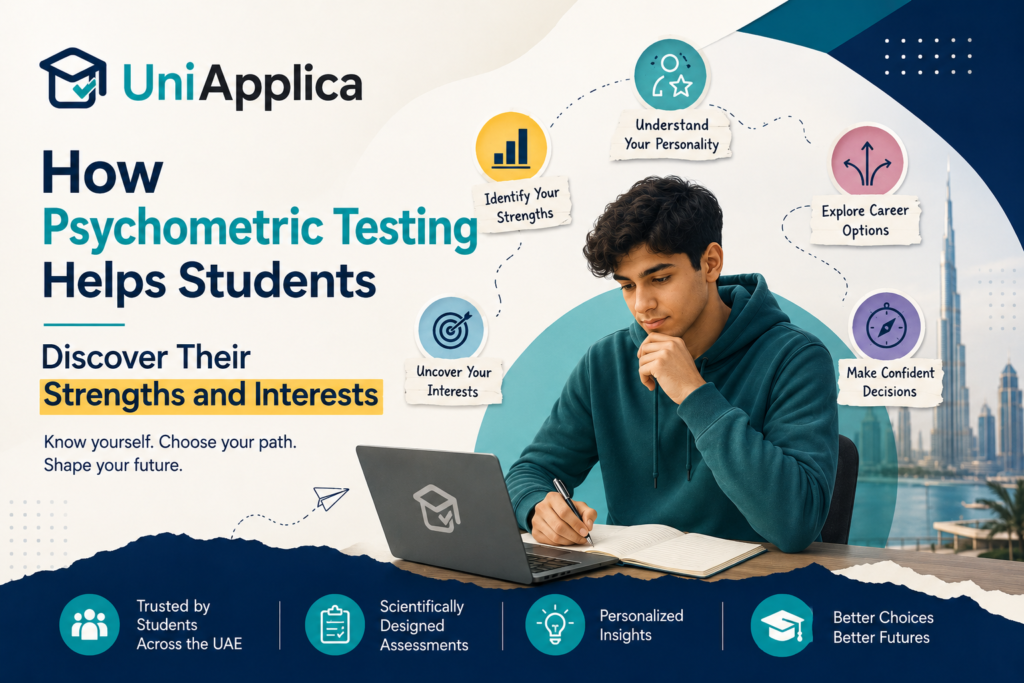
Psychometric testing helps students understand who they are by identifying their strengths, interests, personality traits, aptitude and learning preferences. These insights help students make better educational and career decisions while building confidence in their abilities and future potential.
Why Self-Discovery Matters Before Career Planning
Many students spend years learning about mathematics, science, languages and technology, yet very few spend time learning about themselves.
Before choosing a university programme or career path, students need to understand:
- What motivates them
- What they enjoy doing
- Where their natural strengths lie
- How they learn best
- What environments help them succeed
Without this understanding, educational decisions often become guesswork.
Self-discovery is not just about finding a future career. It is about understanding personal potential and using that knowledge to make informed choices throughout life.
Psychometric testing provides a structured way to begin this journey.
Every Student Has Unique Strengths
One of the biggest myths in education is that intelligence looks the same for everyone.
In reality, students possess different types of strengths.
Some excel at:
- Solving complex problems
- Working with numbers
- Analysing information
- Strategic thinking
Others are naturally skilled at:
- Communication
- Leadership
- Creativity
- Relationship building
Traditional examinations often measure only a small portion of a student’s abilities.
Psychometric assessments help uncover strengths that may not always be visible through academic grades alone.
Understanding the Difference Between Strengths and Interests
Many students assume strengths and interests are the same thing.
They are not.
Strengths
Strengths are abilities that come naturally and allow individuals to perform tasks effectively.
Examples include:
- Logical reasoning
- Leadership
- Communication
- Creativity
- Organisation
Interests
Interests are activities or subjects that naturally capture attention and enjoyment.
Examples include:
- Technology
- Healthcare
- Business
- Psychology
- Design
- Education
A student may be highly skilled at mathematics but deeply interested in entrepreneurship. Another may excel in communication while having a strong interest in law.
Understanding both strengths and interests creates a more complete picture of future opportunities.
How Psychometric Tests Identify Natural Abilities
Psychometric assessments use scientifically developed methods to evaluate different aspects of an individual’s profile.
Rather than asking students what career they want, these assessments explore how they think, learn and solve problems.
Areas commonly assessed include:
Verbal Reasoning
Measures communication and language-related abilities.
Numerical Reasoning
Evaluates comfort with numbers, calculations and quantitative thinking.
Abstract Reasoning
Assesses problem-solving and pattern recognition skills.
Spatial Reasoning
Measures the ability to visualise and manipulate objects mentally.
Critical Thinking
Evaluates analytical decision-making and logical judgement.
Together, these assessments provide valuable insight into a student’s natural strengths.
Why Personality Plays an Important Role
Academic success is important, but personality also influences future career satisfaction.
Two students with similar abilities may enjoy completely different work environments.
For example:
An outgoing student who enjoys interaction may thrive in:
- Teaching
- Sales
- Human Resources
- Counselling
- Marketing
A student who prefers independent work may enjoy:
- Programming
- Engineering
- Research
- Data Analysis
- Design
Psychometric testing helps students understand personality traits such as:
- Communication style
- Leadership tendencies
- Adaptability
- Emotional resilience
- Teamwork preferences
These insights help students evaluate careers that align with their natural preferences.
Discovering Hidden Talents
Many students underestimate their abilities because they compare themselves with others.
A student who struggles with traditional examinations may still possess exceptional strengths in:
- Creativity
- Leadership
- Entrepreneurship
- Public speaking
- Innovation
Psychometric assessments often reveal talents that students have never consciously recognised.
This discovery process can be highly motivating and confidence-building.
Students frequently leave assessments with a greater appreciation of their potential and future possibilities.
Understanding Learning Preferences
Every student learns differently.
Some learn best through:
- Visual demonstrations
- Practical experience
- Reading and writing
- Group discussions
- Independent study
Understanding learning preferences helps students:
- Improve study habits
- Increase productivity
- Enhance academic performance
- Reduce frustration
Psychometric assessments provide valuable information about how students absorb and process information most effectively.
These insights can improve both school and university performance.
Building Confidence Through Self-Awareness
Lack of confidence often stems from uncertainty.
Students who do not fully understand their strengths may doubt their ability to succeed.
Psychometric testing helps replace uncertainty with evidence-based insights.
When students understand:
- What they are good at
- What motivates them
- How they learn
- Which environments suit them
they often become more confident in their decisions.
Confidence plays a significant role in academic achievement, university selection and future career development.
How Self-Discovery Supports Better University Choices
University selection becomes much easier when students understand themselves.
Instead of choosing courses based solely on popularity or external pressure, students can evaluate programmes that genuinely align with their abilities and interests.
Students seeking a Psychometric Test in Dubai, Psychometric Test in Abu Dhabi, Psychometric Test in Sharjah, or a Psychometric Test in UAE often use these assessments before applying to universities.
The results help students:
- Compare academic options
- Explore suitable careers
- Evaluate degree programmes
- Plan educational pathways
This often leads to more informed and confident decisions.
The Connection Between Psychometric Testing and Career Counselling
Psychometric testing provides valuable information, but professional interpretation adds further value.
Career counsellors help students:
- Understand assessment results
- Explore suitable professions
- Evaluate educational opportunities
- Develop long-term plans
- Set realistic goals
Students frequently combine psychometric assessments with Career Counselling in UAE to gain a deeper understanding of their future options.
Together, these services provide a comprehensive approach to self-discovery and career planning.
How UniApplica Helps Students Understand Their Potential
At UniApplica, psychometric assessments are used to help students gain meaningful insights into their strengths, interests and future opportunities.
Students receive support with:
- Psychometric testing
- Career counselling
- University selection guidance
- Study abroad planning
- Educational pathway development
The goal is not simply to recommend careers but to help students understand themselves and make informed decisions with confidence.
Frequently Asked Questions
Can psychometric testing identify hidden strengths?
Yes. Many students discover abilities and talents they had not previously recognised.
Are psychometric tests only for students who are unsure about their future?
No. Even students with clear goals can benefit from gaining deeper self-awareness.
How do psychometric assessments measure interests?
Assessments evaluate preferences, motivations and activities that naturally engage a student.
Can psychometric testing improve confidence?
Yes. Understanding personal strengths often increases confidence and decision-making ability.
Is psychometric testing useful before university applications?
Absolutely. It helps students choose programmes that align with their strengths and interests.
Conclusion
Self-discovery is one of the most important steps in academic and career planning. Students who understand their strengths, interests, personality traits and learning preferences are better equipped to make informed educational decisions.
Psychometric testing provides a scientific and structured way to explore these areas, helping students gain confidence, clarity and direction. By understanding who they are, students can build educational pathways that support long-term success and personal fulfilment.