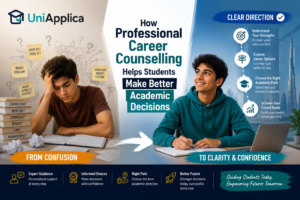
Career counselling in the UAE is a structured guidance process that helps students and professionals choose the right academic and career path based on their interests, aptitude, personality, academic strengths, and future goals. Professional career counsellors use psychometric assessments, one-to-one counselling, university planning, and labour market insights to help individuals make informed decisions about subjects, higher education, and long-term career opportunities.
Table of Contents
- What Is Career Counselling?
- Why Career Counselling Matters More Than Ever
- Who Should Consider Career Counselling?
- Benefits of Career Counselling
- Career Counselling vs Career Advice
- How Career Counselling Works
- Role of Psychometric Assessments
- Choosing the Right University
- Career Counselling for Different School Curricula
- Future Career Opportunities in the UAE
- Frequently Asked Questions
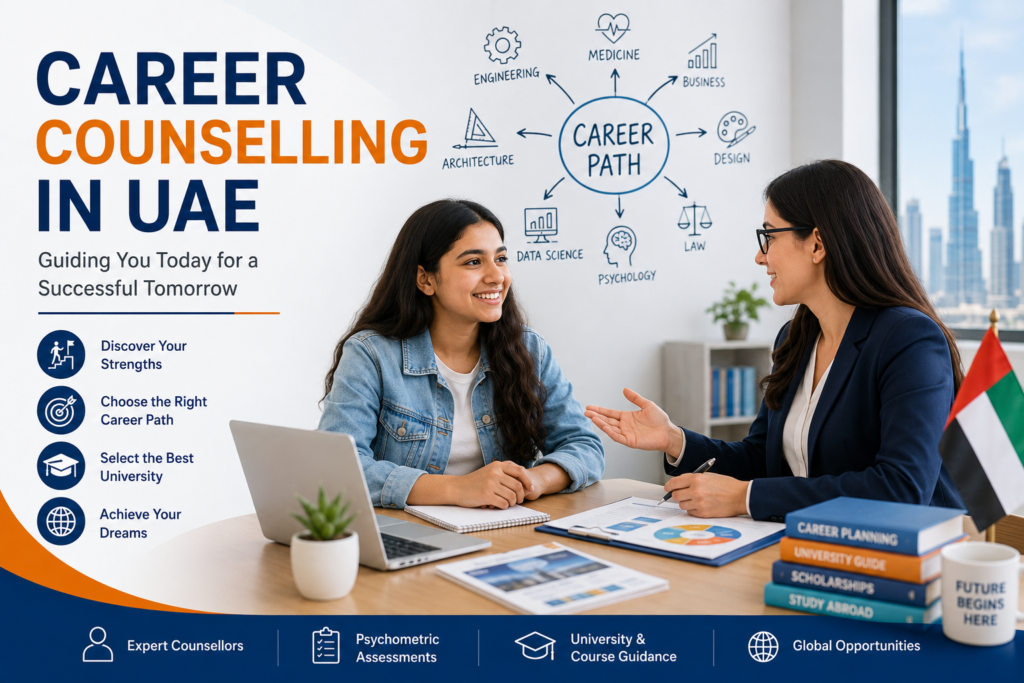
What Is Career Counselling?
Career counselling is a professional and personalised guidance process that helps students and professionals identify the most suitable education pathway and career based on their interests, personality, aptitude, academic performance, skills, values, and long-term aspirations.
Unlike general advice from friends or relatives, career counselling follows a structured methodology. A qualified career counsellor gathers information about the student’s academic background, learning preferences, strengths, challenges, extracurricular interests, and career ambitions before recommending suitable academic pathways and professions.
Career counselling is not about telling students which career to choose. Instead, it helps them understand themselves better so they can make informed decisions with confidence.
A professional career counselling programme may include:
- Personal consultation
- Career interest assessment
- Aptitude evaluation
- Personality assessment
- Psychometric testing
- Academic planning
- Subject selection guidance
- University and course selection
- Study abroad guidance
- Scholarship planning
- Career roadmap development
In today’s rapidly changing world, where new careers emerge every year and technology continues to reshape industries, career counselling provides clarity that helps students prepare for future opportunities rather than simply following traditional career paths.
Why Career Counselling Matters More Than Ever
Students today have access to far more educational opportunities than previous generations. Universities across the UAE and around the world offer thousands of degree programmes in disciplines ranging from Artificial Intelligence and Data Science to Biotechnology, Renewable Energy, Business Analytics, Digital Marketing, and Sustainable Design.
While having more options is beneficial, it also makes decision-making more complex.
Many students ask questions such as:
- Which stream should I choose after Grade 10?
- Which course offers the best career opportunities?
- Should I study in the UAE or abroad?
- Which country matches my career goals?
- Which university provides better industry exposure?
- Which careers will remain in demand over the next decade?
Without proper guidance, students may choose a career because it is popular, because friends selected it, or because of family expectations. These decisions can lead to dissatisfaction, unnecessary course changes, or delayed career progression.
Career counselling helps replace uncertainty with structured planning.
It enables students to understand:
- Their natural strengths
- Personal interests
- Learning style
- Career motivations
- Academic potential
- Emerging employment trends
- Future industry opportunities
Instead of making decisions based on assumptions, students make decisions supported by evidence, expert guidance, and long-term planning.
Who Should Consider Career Counselling?
Career counselling is valuable for individuals at different stages of their education and professional journey.
School Students
Students from Grade 8 onwards can benefit from early career exploration. Understanding strengths and interests before selecting subjects helps students make better academic decisions later.
Students After Grade 10
Choosing between Science, Commerce, or Humanities is one of the most significant academic decisions. Career counselling helps students evaluate their interests, aptitude, and future aspirations before selecting a stream.
Students After Grade 12
After completing school, students must decide on universities, degree programmes, study destinations, and career pathways. Professional guidance simplifies this process by comparing options based on academic profile, goals, and future opportunities.
University Students
Students already enrolled in university often seek guidance when selecting majors, internships, postgraduate programmes, or international exchange opportunities.
Working Professionals
Career counselling is also useful for professionals considering higher education, career transitions, leadership development, or moving into emerging industries.
Parents
Parents play an important role in supporting their children’s career decisions. Career counselling provides objective insights that help families make collaborative decisions based on the student’s abilities and aspirations rather than external pressure.
Benefits of Career Counselling
Professional career counselling provides much more than career suggestions. It helps students build a strong foundation for long-term academic and professional success.
Better Self-Awareness
Students gain a deeper understanding of their:
- Interests
- Personality
- Aptitude
- Skills
- Learning preferences
- Communication style
- Leadership potential
This self-awareness forms the basis of informed career planning.
Better Academic Decisions
Career counselling helps students choose subjects and degree programmes that align with both their interests and future aspirations.
Reduced Stress and Confusion
Career planning often creates anxiety for students and parents. A structured counselling process provides clarity and reduces uncertainty by creating a realistic education roadmap.
Improved University Selection
Instead of choosing universities based only on rankings, students learn to evaluate curriculum, internships, accreditation, faculty expertise, career services, scholarships, and graduate employability.
Better Career Confidence
Students who understand why they have chosen a particular career pathway are generally more motivated and confident throughout their education.
Career Counselling vs Career Advice
Many people confuse career counselling with career advice, but they are not the same.
| Career Counselling | Career Advice |
| Personalised and structured | Usually general and opinion-based |
| Uses psychometric assessments | Based on personal experience |
| Conducted by trained professionals | Often provided by friends or family |
| Focuses on long-term planning | Focuses on immediate suggestions |
| Considers aptitude, interests, personality, and goals | May not consider individual differences |
Advice can be helpful, but professional career counselling provides a systematic approach that helps students make informed decisions based on objective insights rather than assumptions.
How Career Counselling Works
Many students believe that career counselling is simply a conversation where a counsellor recommends a career. In reality, professional career counselling follows a structured process that helps students understand themselves before making important academic and career decisions.
At UniApplica, career counselling is designed to provide personalised guidance based on scientific assessments, education planning, and future career opportunities.
Step 1: Understanding the Student
The first stage focuses on getting to know the student beyond their academic marks.
A career counsellor discusses:
- Academic performance
- Favourite and least favourite subjects
- Hobbies and extracurricular activities
- Personal interests
- Career aspirations
- Family expectations
- Preferred study destination
- Budget considerations
- Long-term goals
This conversation helps create a complete profile of the student before any recommendations are made.
Step 2: Psychometric Assessment
A psychometric assessment is one of the most valuable tools used during career counselling.
Rather than relying on assumptions, these assessments evaluate multiple aspects of a student’s profile, including:
- Personality
- Career interests
- Aptitude
- Logical reasoning
- Numerical ability
- Verbal reasoning
- Learning preferences
- Behavioural style
The objective is not to tell students what career they must choose. Instead, the assessment provides objective insights that support better decision-making.
Step 3: Career Exploration
Once the assessment is complete, the counsellor discusses career options that align with the student’s strengths and aspirations.
Students explore careers across multiple industries instead of focusing only on traditional professions.
Examples include:
- Artificial Intelligence
- Cybersecurity
- Medicine
- Engineering
- Data Science
- Finance
- Psychology
- Law
- Architecture
- Digital Marketing
- Aviation
- Biotechnology
- Environmental Science
- Hospitality
- Entrepreneurship
Students learn about educational requirements, skills, future demand, and possible career progression for each field.
Step 4: Subject and Stream Selection
For students after Grade 10, selecting the right stream is a crucial decision.
Career counselling helps students compare:
Science
Suitable for students interested in:
- Medicine
- Engineering
- Research
- Artificial Intelligence
- Biotechnology
- Environmental Science
Commerce
Suitable for students interested in:
- Business
- Finance
- Accounting
- Economics
- Marketing
- Entrepreneurship
Humanities (Arts)
Suitable for students interested in:
- Psychology
- Law
- Journalism
- International Relations
- Education
- Media
- Design
The choice should always be based on the student’s interests, aptitude, and future goals rather than social pressure or assumptions.
Step 5: University and Country Selection
After choosing a career direction, the next step is selecting the right university and, if applicable, the right country.
A counsellor helps students compare:
- Course curriculum
- University accreditation
- Global recognition
- Internship opportunities
- Research facilities
- Industry partnerships
- Graduate employability
- Tuition fees
- Scholarships
- Campus environment
- Career support services
Rather than recommending a university solely because of its ranking, career counselling focuses on identifying institutions that best match the student’s profile and aspirations.
The Role of Psychometric Assessments
Psychometric assessments are often misunderstood. Some students believe these tests decide their future career. In reality, they are decision-support tools that provide objective insights into how a student thinks, learns, and interacts with the world.
A comprehensive psychometric assessment typically measures:
- Career interests
- Personality traits
- Aptitude
- Analytical thinking
- Problem-solving ability
- Leadership potential
- Communication preferences
- Learning style
- Emotional intelligence
These assessments help students understand themselves more clearly and provide counsellors with additional information for personalised recommendations.
Benefits of Psychometric Assessments
- Improves self-awareness
- Reduces career confusion
- Supports subject selection
- Helps compare career pathways
- Encourages informed decision-making
- Builds confidence
The greatest value comes when assessment results are interpreted by an experienced career counsellor rather than viewed in isolation.
Choosing the Right University
Selecting a university should involve more than comparing rankings.
Students should evaluate several important factors before making a decision.
Accreditation
Choose universities recognised by relevant education authorities and employers.
Course Curriculum
Review the subjects taught, practical learning opportunities, projects, and industry relevance.
Faculty Expertise
Experienced faculty members with academic and industry backgrounds can enrich the learning experience.
Internship Opportunities
Practical experience plays an important role in preparing students for employment. Universities with strong internship programmes often provide better career outcomes.
Scholarships
Scholarships can significantly reduce the financial burden of higher education. Students should explore merit-based, need-based, sports, and international scholarships.
Graduate Employability
Research graduate employment rates, employer partnerships, alumni success stories, and career services before making a final decision.
Career Counselling for Different School Curricula in the UAE
The UAE has one of the most diverse education systems in the world. Career counselling should reflect the specific needs of each curriculum.
CBSE Curriculum
Students often require guidance before choosing Science, Commerce, or Humanities after Grade 10 and while selecting universities after Grade 12.
British Curriculum
Students benefit from guidance when selecting GCSE and A Level subjects that support their preferred university programmes.
International Baccalaureate (IB)
Career counselling helps students choose Higher Level and Standard Level subjects that align with future career aspirations.
American Curriculum
Students receive support with subject planning, Advanced Placement (AP) courses, university applications, and scholarship opportunities.
UAE Ministry of Education Curriculum
Career guidance helps students compare local and international higher education opportunities while identifying careers that match their strengths and interests.
Future Career Opportunities in the UAE
The UAE is investing heavily in innovation, technology, sustainability, healthcare, and entrepreneurship. As industries evolve, students should prepare for careers that are expected to grow over the next decade.
Some of the fastest-growing career fields include:
- Artificial Intelligence
- Machine Learning
- Cybersecurity
- Data Analytics
- Cloud Computing
- Renewable Energy
- Healthcare Technology
- FinTech
- Aviation Management
- Supply Chain Management
- Hospitality and Tourism
- Digital Marketing
- Robotics
- Sustainable Construction
- Environmental Science
Career counselling helps students understand not only what careers are available today but also which skills will remain valuable in the future.
Frequently Asked Questions
What is the best age to start career counselling?
Students can begin career counselling from Grade 8 onwards. Early guidance allows them to make informed decisions about subject selection and future education.
Is career counselling only for students?
No. University students, graduates, and working professionals can also benefit from career counselling when planning higher education or changing careers.
Can career counselling help with studying abroad?
Yes. Career counselling often includes university selection, country comparison, scholarship guidance, and application planning for students interested in international education.
Are psychometric tests compulsory?
No. However, they provide valuable insights that complement counselling discussions and support better decision-making.
How long does the career counselling process take?
The duration varies depending on the student’s needs. Some students require a few sessions, while others benefit from ongoing guidance during university applications.
Can parents attend career counselling sessions?
Yes. Parents are encouraged to participate, especially for younger students, while ensuring the student’s interests remain central to the planning process.
Does career counselling guarantee career success?
No counsellor can guarantee success. Career counselling improves decision-making by helping students understand themselves and choose pathways that align with their abilities and aspirations.
Conclusion
Career decisions influence not only higher education but also future employment, financial stability, and personal satisfaction. In a rapidly changing world where new industries continue to emerge, students need more than advice—they need structured guidance based on reliable information and self-awareness.
Professional career counselling helps students understand their strengths, evaluate career opportunities, compare universities, and build a practical roadmap for the future. Whether you are deciding on a stream after Grade 10, selecting a university after Grade 12, or planning to study abroad, expert guidance can help you make informed decisions with confidence.
The earlier students begin exploring their interests and abilities, the better prepared they are to build a successful and fulfilling career.
Ready to Plan Your Future?
Choosing the right career starts with understanding yourself.
At UniApplica, our experienced career counsellors help students across the UAE make informed decisions through personalised counselling, psychometric assessments, university selection guidance, and study abroad planning.
Whether you’re in Dubai, Abu Dhabi, Sharjah, or anywhere in the UAE, expert guidance can help you confidently choose the right academic and career path.
Take the first step today by booking a personalised career counselling session and start building a future aligned with your strengths, interests, and ambitions.