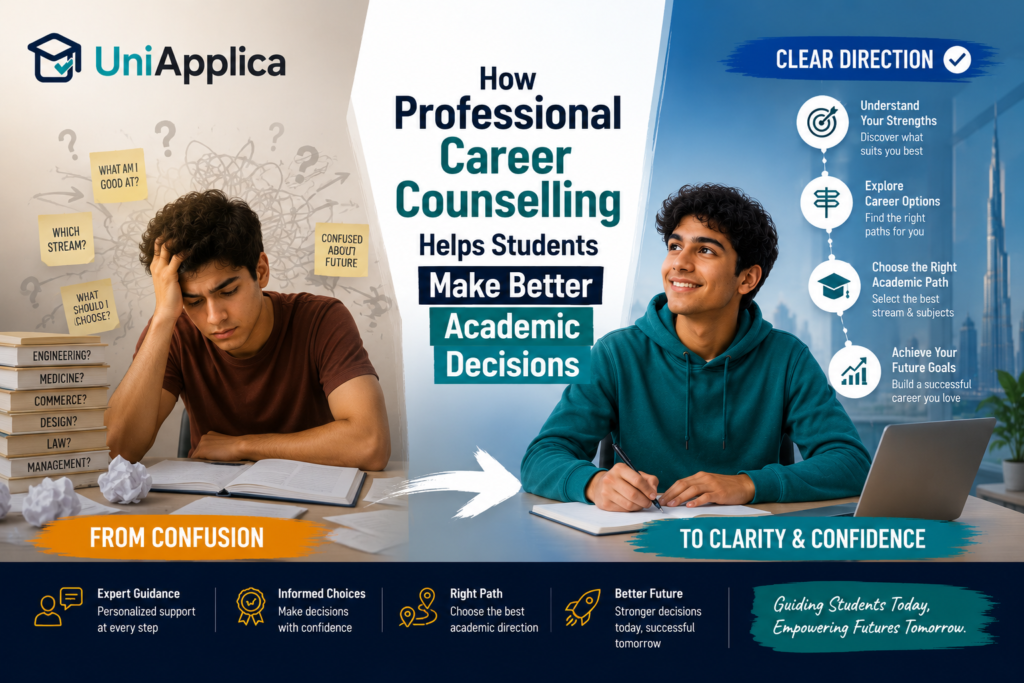
Professional career counselling helps students make better academic decisions by identifying their strengths, interests, aptitude and future goals. Through personalised guidance, students can choose suitable subjects, university programmes and career pathways that align with their long-term aspirations.
Why Academic Decisions Shape Future Opportunities
Every educational decision creates opportunities and limitations.
The subjects students choose in secondary school influence the university programmes available to them. University programmes influence future career opportunities, and career choices often affect long-term professional growth.
Despite the importance of these decisions, many students make academic choices without a clear understanding of:
- Their strengths
- Their interests
- Their career goals
- Industry requirements
- Future opportunities
As a result, students may find themselves pursuing courses that do not align with their abilities or aspirations.
Professional career counselling helps students make these decisions with greater clarity and confidence.
Academic Success Begins With Self-Awareness
Many students focus exclusively on grades when planning their future.
While academic performance is important, it is only one piece of the puzzle.
Students should also understand:
What Motivates Them
Some students enjoy solving technical problems, while others are motivated by helping people, leading teams or creating innovative solutions.
How They Learn Best
Learning preferences influence academic performance and programme suitability.
What Environments Suit Them
Certain students thrive in structured environments, while others prefer flexibility and independence.
Career counselling helps students explore these factors before making important educational decisions.
Why Students Struggle With Academic Choices
Modern education offers more options than ever before.
Students must choose between:
- Different school subjects
- Academic streams
- University programmes
- Specialisations
- Study destinations
This abundance of choice can create confusion.
Common challenges include:
Too Much Information
Students are often overwhelmed by the volume of information available online.
Conflicting Advice
Family members, friends, teachers and social media may all offer different recommendations.
Fear of Making Mistakes
Many students worry that one wrong decision could negatively affect their future.
Lack of Career Knowledge
Students may understand subjects but have limited awareness of related career opportunities.
Professional guidance helps simplify this process.
The Role of Career Counselling in Educational Planning
Career counselling provides a structured framework for decision-making.
Rather than focusing on a single course or profession, counsellors help students understand the bigger picture.
This includes:
- Educational pathways
- Career progression
- Industry trends
- Skill requirements
- Long-term opportunities
The goal is to ensure that academic decisions support future aspirations.
Choosing the Right Subjects After School
One of the first major decisions students make involves subject selection.
Students often choose subjects based on:
- Popularity
- Peer influence
- Family expectations
- Perceived earning potential
However, these factors do not always reflect personal suitability.
Professional career counselling helps students evaluate:
Strengths
What subjects align with natural abilities?
Interests
What topics generate genuine enthusiasm?
Future Goals
Which subjects support long-term career aspirations?
Making informed subject choices creates a stronger academic foundation.
How Career Counselling Supports University Selection
University selection is one of the most important educational decisions students make.
Many students focus solely on university rankings.
While rankings have value, they do not always indicate programme suitability.
Career counsellors help students evaluate:
- Programme content
- Career outcomes
- Industry demand
- Learning style compatibility
- Long-term opportunities
This approach ensures that students choose programmes based on fit rather than reputation alone.
Understanding the Importance of Psychometric Testing
Psychometric assessments often complement career counselling.
These assessments help identify:
- Personality traits
- Career interests
- Aptitude strengths
- Learning preferences
- Behavioural tendencies
Preventing Costly Academic Mistakes
Changing university programmes can be expensive and time-consuming.
Students who choose unsuitable courses may experience:
- Reduced motivation
- Poor academic performance
- Programme transfers
- Delayed graduation
- Additional financial costs
Career counselling reduces these risks by helping students make informed choices before committing to an educational pathway.
Prevention is often more effective than correction.
Supporting Students During Key Educational Transitions
Students encounter several important transition points throughout their academic journey.
Examples include:
Secondary School to Higher Secondary Education
Students must select appropriate subjects and streams.
School to University
Students must choose degree programmes and institutions.
Undergraduate to Postgraduate Education
Students must evaluate specialisations and career opportunities.
Career counselling provides guidance at each stage, helping students navigate transitions effectively.
Helping Students Explore Emerging Career Opportunities
The modern job market is evolving rapidly.
New careers continue to emerge in fields such as:
- Artificial Intelligence
- Data Science
- Cybersecurity
- Renewable Energy
- Healthcare Technology
- Digital Marketing
Many students are unfamiliar with these opportunities.
Career counsellors help students explore both traditional and emerging professions, ensuring they make decisions based on current market realities rather than outdated assumptions.
Why Parents Value Professional Career Guidance
Parents play a significant role in educational planning.
However, today’s academic and career landscape is far more complex than it was for previous generations.
Professional guidance helps parents:
- Understand student strengths
- Explore educational options
- Evaluate career opportunities
- Support informed decision-making
This collaborative approach often reduces conflict and improves confidence in major educational choices.
Career Counselling and Study Abroad Planning
Many students aspire to study internationally.
However, choosing a study destination should not be the first step.
Students should first determine:
- Academic interests
- Career goals
- Preferred learning environments
- Long-term aspirations
Students considering a Study Abroad Consultant in UAE often benefit from career counselling before selecting international programmes.
Clear objectives lead to better educational decisions abroad.
How UniApplica Supports Academic Decision-Making
At UniApplica, career counselling is designed to help students make informed educational choices.
Support may include:
- Career counselling
- Psychometric testing
- University selection guidance
- Study abroad planning
- Academic pathway development
The objective is to help students align educational decisions with personal strengths, interests and future goals.
Frequently Asked Questions
What is career counselling?
Career counselling is a professional guidance process that helps students explore educational and career opportunities based on their strengths, interests and aspirations.
When should students seek career counselling?
Students often benefit before selecting academic streams, university programmes or future career pathways.
Can career counselling help with university selection?
Yes. Career counsellors help students evaluate programmes, institutions and future opportunities.
Is psychometric testing necessary?
Psychometric testing is not mandatory but can provide valuable insights that support educational planning.
Can career counselling help with study abroad decisions?
Absolutely. Career counselling helps students identify suitable international programmes and destinations.
Conclusion
Academic decisions have a significant impact on future opportunities. Yet many students make these choices without fully understanding their strengths, interests or long-term goals.
Professional career counselling provides a structured approach to educational planning, helping students evaluate options objectively and make informed decisions. Whether choosing school subjects, university programmes or international study opportunities, expert guidance helps students build a stronger foundation for future success.