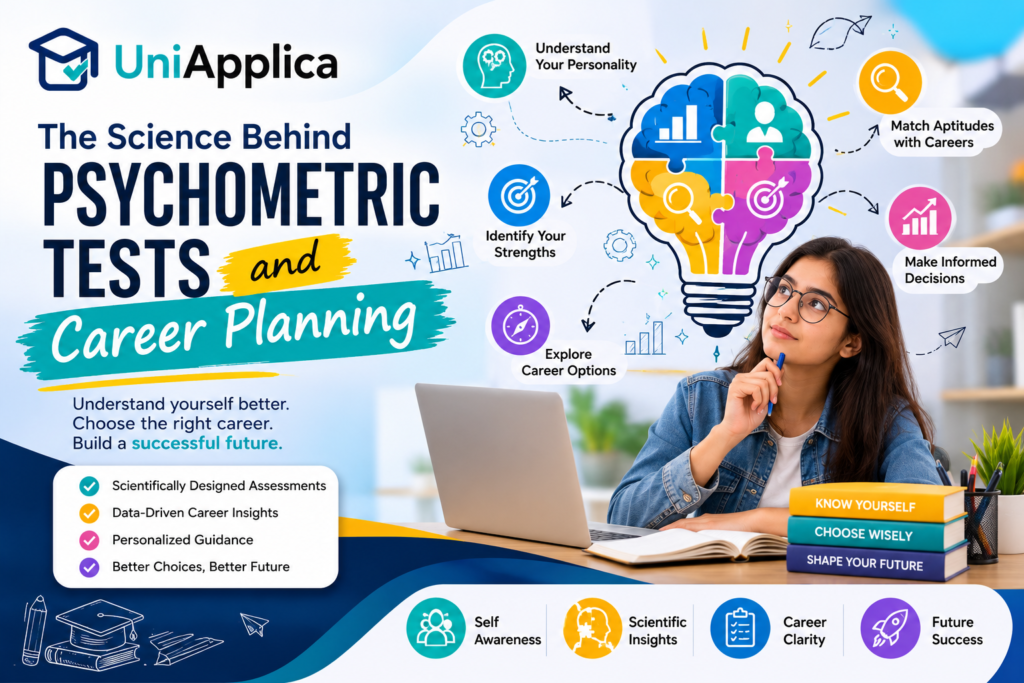
Psychometric tests are scientifically designed assessments that measure personality traits, aptitude, interests and behavioural preferences. These assessments use psychological research and statistical validation to help students make informed educational and career decisions based on evidence rather than assumptions.
Why Career Decisions Should Be Based on Evidence
When students choose a career, they often rely on advice from family members, teachers, friends or social media.
While these sources can provide useful perspectives, they may not always reflect a student’s unique strengths, interests and potential.
Imagine choosing a university course worth thousands of pounds or dirhams based purely on guesswork. Most students would agree that such an important decision deserves a more structured approach.
This is where psychometric testing becomes valuable.
Rather than relying on assumptions, psychometric assessments provide measurable insights that help students understand themselves through scientifically validated methods.
What Makes a Psychometric Test Scientific?
Many students assume psychometric tests are simply online quizzes.
Professional psychometric assessments are very different.
Before an assessment is used by career counsellors, psychologists or educational institutions, it undergoes extensive research and testing.
Researchers study:
- Human behaviour
- Personality traits
- Learning patterns
- Cognitive abilities
- Career satisfaction factors
The data collected from thousands of individuals helps create assessment models that can reliably measure specific characteristics.
This process transforms psychological observations into measurable information.
Understanding Psychometrics
The word “psychometric” combines two concepts:
Psychology
The scientific study of human behaviour, thoughts and emotions.
Measurement
The process of collecting data and evaluating characteristics objectively.
Psychometrics is therefore the science of measuring psychological traits and abilities.
These measurements help professionals understand how individuals think, learn, communicate and solve problems.
The Role of Psychology in Career Planning
Career planning is not simply about choosing a profession.
It involves understanding several important factors:
- Personality
- Interests
- Aptitude
- Values
- Motivation
- Learning preferences
Psychologists have spent decades studying how these factors influence educational and career success.
Research consistently shows that people are more likely to thrive when their work aligns with their natural preferences and strengths.
Psychometric testing helps identify these patterns before students make important educational decisions.
Reliability: Why Consistency Matters
One of the most important scientific principles behind psychometric testing is reliability.
Reliability refers to consistency.
If a student takes a professionally developed psychometric assessment today and repeats it under similar conditions later, the results should remain reasonably consistent.
For example:
If an assessment identifies strong analytical abilities today, it should not suddenly indicate weak analytical abilities a few weeks later without a significant reason.
Reliable assessments provide dependable information that students and counsellors can trust.
Validity: Measuring What Matters
Another important scientific principle is validity.
Validity refers to accuracy.
A valid assessment measures exactly what it claims to measure.
For example:
If an aptitude assessment claims to evaluate logical reasoning, it should genuinely assess logical reasoning rather than unrelated abilities.
Without validity, assessment results become meaningless.
Professional psychometric assessments undergo extensive testing to ensure they accurately evaluate specific traits and abilities.
The Different Types of Psychometric Assessments
Psychometric testing is not a single assessment.
Different tools measure different aspects of an individual’s profile.
Personality Assessments
These assessments explore:
- Behavioural preferences
- Communication styles
- Leadership tendencies
- Emotional responses
- Social interaction patterns
Aptitude Assessments
These evaluate:
- Numerical reasoning
- Verbal reasoning
- Logical thinking
- Abstract reasoning
- Problem-solving abilities
Interest Assessments
These identify:
- Career preferences
- Subject interests
- Motivational factors
- Professional aspirations
Together, these assessments provide a comprehensive understanding of a student’s potential.
Why Personality Influences Career Success
Many students focus exclusively on academic performance.
However, personality plays an equally important role in long-term career satisfaction.
For example:
An individual who enjoys frequent interaction with people may thrive in:
- Teaching
- Counselling
- Sales
- Human Resources
- Business Development
Meanwhile, someone who prefers independent analytical work may excel in:
- Engineering
- Software Development
- Data Science
- Research
- Finance
Neither personality type is better than the other.
The key is understanding which environments are most compatible with individual preferences.
How Aptitude Testing Identifies Natural Potential
Aptitude measures a person’s natural ability to learn or perform certain tasks.
Unlike school examinations, aptitude assessments focus on potential rather than acquired knowledge.
Aptitude testing may reveal strengths in:
- Mathematics
- Logic
- Communication
- Analytical thinking
- Creative reasoning
These insights help students identify academic and professional pathways where they are likely to perform well.
Students often discover abilities they were previously unaware of.
The Importance of Career Interests
Interest plays a major role in motivation.
Students are generally more engaged when studying subjects they genuinely enjoy.
Interest assessments help identify attraction towards areas such as:
- Healthcare
- Technology
- Business
- Psychology
- Design
- Education
- Engineering
- Media
When interests and abilities align, educational outcomes often improve significantly.
This is one reason why psychometric testing has become increasingly popular among students across the UAE.
Why More UAE Students Are Using Psychometric Testing
Educational opportunities in Dubai, Abu Dhabi and Sharjah have expanded significantly over the past decade.
Students now have access to:
- International universities
- Study abroad programmes
- Emerging industries
- Specialised degree pathways
While these opportunities create possibilities, they also increase complexity.
Students considering a Psychometric Test in Dubai, Psychometric Test in Abu Dhabi, Psychometric Test in Sharjah, or a Psychometric Test in UAE are often looking for objective guidance before making important decisions.
Psychometric assessments help reduce uncertainty and improve confidence.
Research Supports Better Decision-Making
Numerous studies in psychology and education suggest that self-awareness improves decision-making.
Students who understand:
- Their strengths
- Their interests
- Their personality traits
- Their learning preferences
are generally more confident when selecting courses and careers.
Rather than following trends or external pressure, they can make choices based on evidence and personal suitability.
This often leads to:
- Greater academic engagement
- Improved motivation
- Better educational outcomes
- Increased career satisfaction
Why Psychometric Testing Works Best With Career Counselling
Assessment results provide valuable information, but interpretation is equally important.
Professional career counsellors help students:
- Understand assessment findings
- Explore suitable career pathways
- Compare educational options
- Set realistic goals
- Develop action plans
Students frequently combine psychometric assessments with Career Counselling in UAE to gain a deeper understanding of their future opportunities.
The combination of scientific assessment and professional guidance provides the strongest foundation for informed decision-making.
How UniApplica Uses Scientific Career Assessment
At UniApplica, psychometric assessments form part of a structured guidance process designed to help students make confident educational choices.
Students can receive support with:
- Psychometric testing
- Career counselling
- University selection
- Study abroad planning
- Educational pathway development
The objective is not to tell students what career they should pursue but to provide evidence-based insights that help them make informed decisions.
Frequently Asked Questions
Are psychometric tests scientifically accurate?
Professionally developed psychometric assessments are based on extensive psychological research and statistical validation.
What is the difference between aptitude and personality testing?
Aptitude testing measures natural abilities, while personality assessments evaluate behavioural preferences and communication styles.
Can psychometric tests predict future success?
No assessment can predict the future. However, psychometric tests provide valuable insights that support informed decision-making.
Why are psychometric tests useful before university selection?
They help students identify strengths, interests and educational pathways that align with their potential.
Can psychometric testing help with study abroad planning?
Yes. Understanding strengths and interests can help students select suitable international programmes and destinations.
Conclusion
Career planning should be based on more than assumptions and opinions. Psychometric testing provides a scientific approach to understanding personality, aptitude and interests, helping students make informed educational decisions.
As students across Dubai, Abu Dhabi, Sharjah and the wider UAE face an increasing number of educational opportunities, evidence-based career planning has become more important than ever. When combined with professional guidance, psychometric assessments provide a powerful foundation for long-term academic and career success.